The List That Kept Me Going
How a notebook, some circles, and a Coffee Bean planner became Tamelo - a task system designed for overwhelmed, procrastinating, very human people.
There’s a version of the pandemic story that goes like this: people baked sourdough, learned languages, launched businesses, came out the other side transformed and productive. I have friends who lived that version.
That wasn’t mine.
In 2020, I was already carrying more than most. A few months earlier, my thyroid cancer, which I thought I’d dealt with after a total thyroidectomy, came back. It had spread to my lymph nodes. I was waiting to begin treatment when the world shut down. Hospitals became places you didn’t go unless you absolutely had to, and my case, while serious, wasn’t as urgent as what was filling those wards. So I waited. I just moved back into my parents’ house. I just ended an eight-year relationship. And the world, strangely, seemed to agree that staying still was the right thing to do.
So I stayed still. I worked my night shift dev job. I swiped through dating apps looking for something to feel. And I waited.
I’m not going to pretend I remember those first two years clearly. It’s all a blur, the way difficult periods tend to be: not dramatic, just formless. I was grateful to be alive. I still am. But gratitude and momentum are different things, and for a long time, I had the first without the second.
The Notebook
Somewhere around 2021, something shifted. I can’t point to a single moment. I started working out. I started thinking about what I actually wanted to do with the time I had, which, it turned out, I had a lot of. And I started noticing a particular kind of exhaustion that had nothing to do with sleep.
My brain was full. Not of anything useful, just lists. Tasks I needed to do, tasks I’d been meaning to do, tasks I kept deferring and then feeling guilty about deferring. Every morning I’d write them out again, recopying the same things I hadn’t done the day before, and by the time I’d finished rewriting, I’d already used up whatever motivation I’d woken up with.
The list was supposed to help. Instead, it became its own task.
I started experimenting. What if I didn’t rewrite? What if I wrote everything down once? Every single thing I could think of, no matter how small or embarrassing or distant, just to get it out of my head? And then, instead of prioritizing it or ordering it or deciding what mattered most, I just noted when I intended to think about it?
That was the beginning of the system.
I had a planner I’d picked up from Coffee Bean & Tea Leaf back when they were doing their annual planner campaign, trying to compete with Starbucks. I never used it then, of course. It sat in a drawer doing nothing. But when I finally opened it in 2021, I realized the layout was nearly perfect for what I was building in my head. So I began using it as my weekly planner as soon as 2022 began.
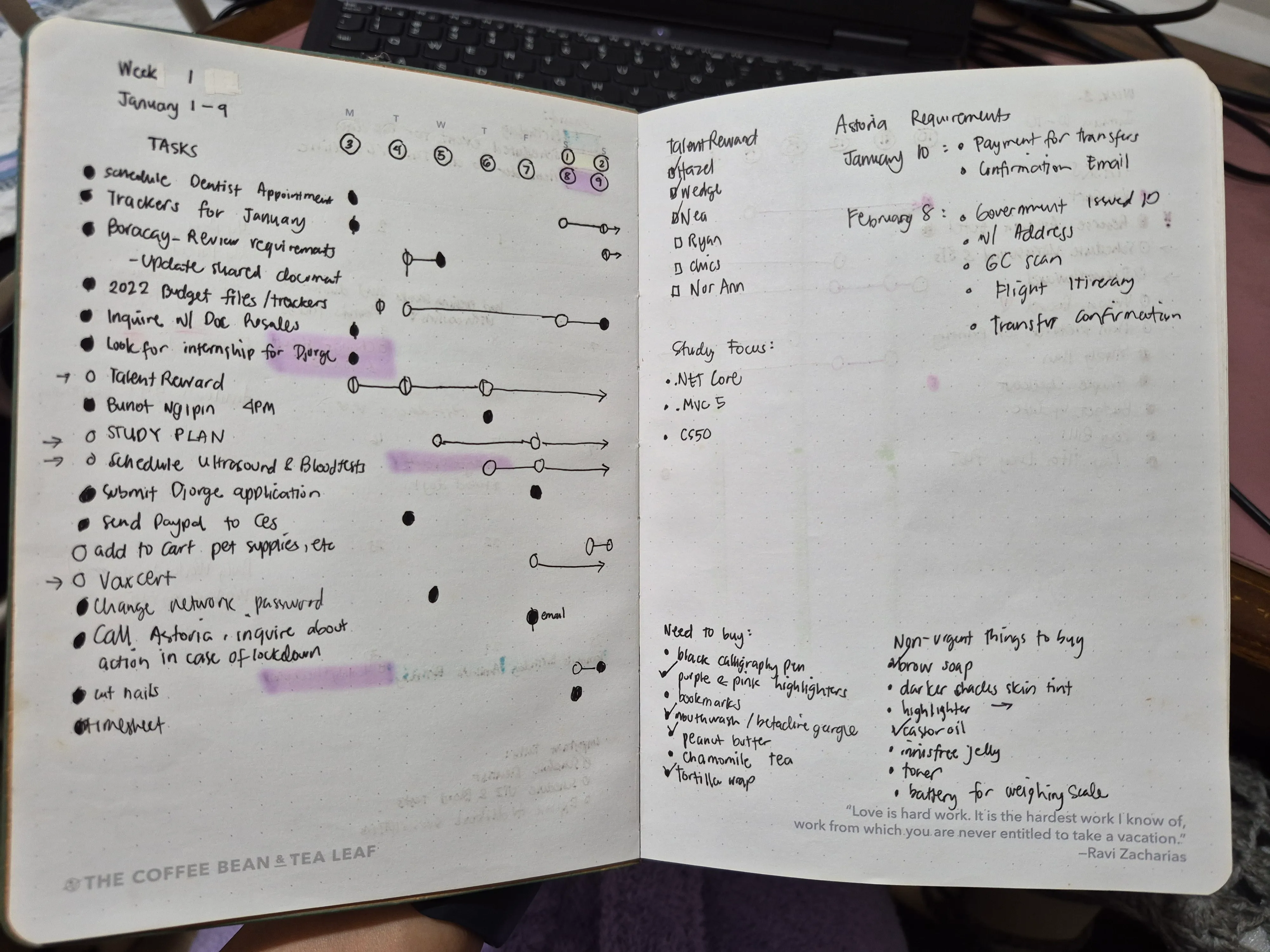
It was undated. Monthly spreads with blank calendar boxes, weekly spreads in between. Each weekly spread had a specific layout: the left page split into two columns: a blank left panel for writing tasks, and a right panel with just the days of the week along the top: S M T W T F S. The right page was completely open.
I used that left panel as a brain dump. Every task I could think of, written out in a list. Everything - the laundry, the side project, the doctor’s appointment I kept putting off, the thing I wanted to learn, the message I owed someone. All of it, out of my head and onto paper.
Then, for each task, I drew an empty circle under the day I intended to get to it.
What the Circles Meant
When Thursday came, I knew which circles were waiting. I didn’t have to reload the whole list into my brain. It was already there, holding the thought for me.
The circles had a simple language:
- Empty circle: this is intended for this day
- Half-filled circle (vertical line drawn through): started; something happened
- Solid circle: done; shaded in completely
Starting is different from planning. Starting means something happened. The half-filled circle existed because I needed a way to say I was here — even when I couldn’t finish.
And when I didn’t finish, when Thursday passed and that circle stayed empty, I didn’t rewrite the task. I just drew another circle on a new day and connected them with an arrow. Moved to Saturday. No judgment, no failure. Just: it didn’t happen then, so let’s try again. The arrow was almost gentle about it.
If a task rolled to the next week, I’d draw an arrow to the next page and carry it forward. The task didn’t disappear because I’d missed it. It just waited. Patiently. Without the guilt that a rewritten list had always managed to deliver.
When I started being consistent with this — when the brain dump became a habit and the circles started filling in, something changed. The mental load lightened. I wasn’t managing a list anymore. I was just looking at a page, finding a circle, and doing the thing.
When It Worked for Someone Else
I shared the system with my sister. She was a stay-at-home mom. Her husband is in the military, her son needed special attention, and she was drowning in everything she needed to do while also feeling the pull to contribute more to the household income. I recognized the look. The mental overload that makes you feel behind before the day has even started.
I made her a Canva template (check it out here!), an illustration of the system with instructions, so she could try it herself.
A few weeks later, she came back to me, tired in the best possible way. She’d shaded all her boxes. Not most of them, all of them. She had done everything she’d set out to do, and she was exhausted from actually doing things rather than from the weight of things undone.
The Gap in the Market
The Coffee Bean & Tea Leaf planner was eventually discontinued. I looked for something similar and couldn’t find it. Most weekly spreads are horizontal, or too decorated, or structured in ways that didn’t fit the system. So I started drawing it by hand in regular notebooks, recreating the layout myself each week. It’s tedious, but I wanted to stick to it thinking that it’s the only way I could keep going. I just convinced myself that drawing that setup each month is therapy, I was grounding myself.
That worked, but it was friction. And friction, for people like me, is dangerous.
I’m a developer. I’ve been building things professionally for years. At some point, the thought that had been sitting in the back of my mind became impossible to ignore: this system should exist as an app. Not a different system dressed up like this one. This system, exactly as it works, but digital.
That’s what Tamelo is.
The Digital Version
The core mechanic translated almost directly. Where my notebook had a list of tasks down the left and seven columns of days across the top, Tamelo has a weekly grid. Each task has a row. Each day has a clickable circle.
Rescheduling isn’t a failure state. You just click a different day. The history is there if you want to see it. Tamelo keeps an audit trail of everything you do, but nothing in the interface makes you feel bad about a task that moved.
I added things the notebook couldn’t do: project groupings, a Kanban view, notes and details per task, activity history. But I was careful not to add things that would break what made the system work in the first place.
Who This Is For
If you’ve ever opened a productivity app and felt immediately worse, too many features, too much structure, a vague sense that you’re already failing, this was built for you.
If you have more tasks living in your head than you could ever write down, and the act of writing them down feels like it should help but somehow doesn’t, this was built for you.
If you’re neurodivergent, or think you might be, or just find that your brain works better when the expectations are low and the flexibility is high, this was built for you.
And if you’re going through something hard and just need a system that doesn’t add to the weight of it, one that says it’s okay, you can try again Thursday, this was especially built for you.
I know what it’s like to lose time to circumstances you didn’t choose. I know what it’s like to want to move forward and not be able to. This system didn’t fix any of that. But it helped me stop fighting my own brain about the laundry while I figured out the bigger things.
Sometimes that’s enough. Sometimes that’s everything.
Next in the series: Why It’s Called Tamelo — the word search, the Japanese concepts, and the moment a made-up word clicked into place.